The exoplanet sulfur shoreline
We use a coupled VULCAN–PICASO framework to study how atmospheric chemistry and radiative–convective structure jointly shape the distribution of sulfur-bearing species across exoplanet environments.
Undergraduate researcher · National Taiwan University
Planetary atmospheres & exoplanets
B.S. in PhysicsNational Taiwan University · expected June 2027
Undergraduate Research AssistantAcademia Sinica Institute of Astronomy and Astrophysics (ASIAA) · PI: Shang-Min Tsai
Caltech SURF Research FellowKnutson Group · PI: Heather A. Knutson
Caltech SURF Research FellowYuk Group · PI: Yuk L. Yung
I study how planetary environments shape atmospheric chemistry, thermal structure, and atmospheric escape. I connect models and observations in both directions: simulations predict measurable signatures, while observations test those predictions and reveal missing physics.
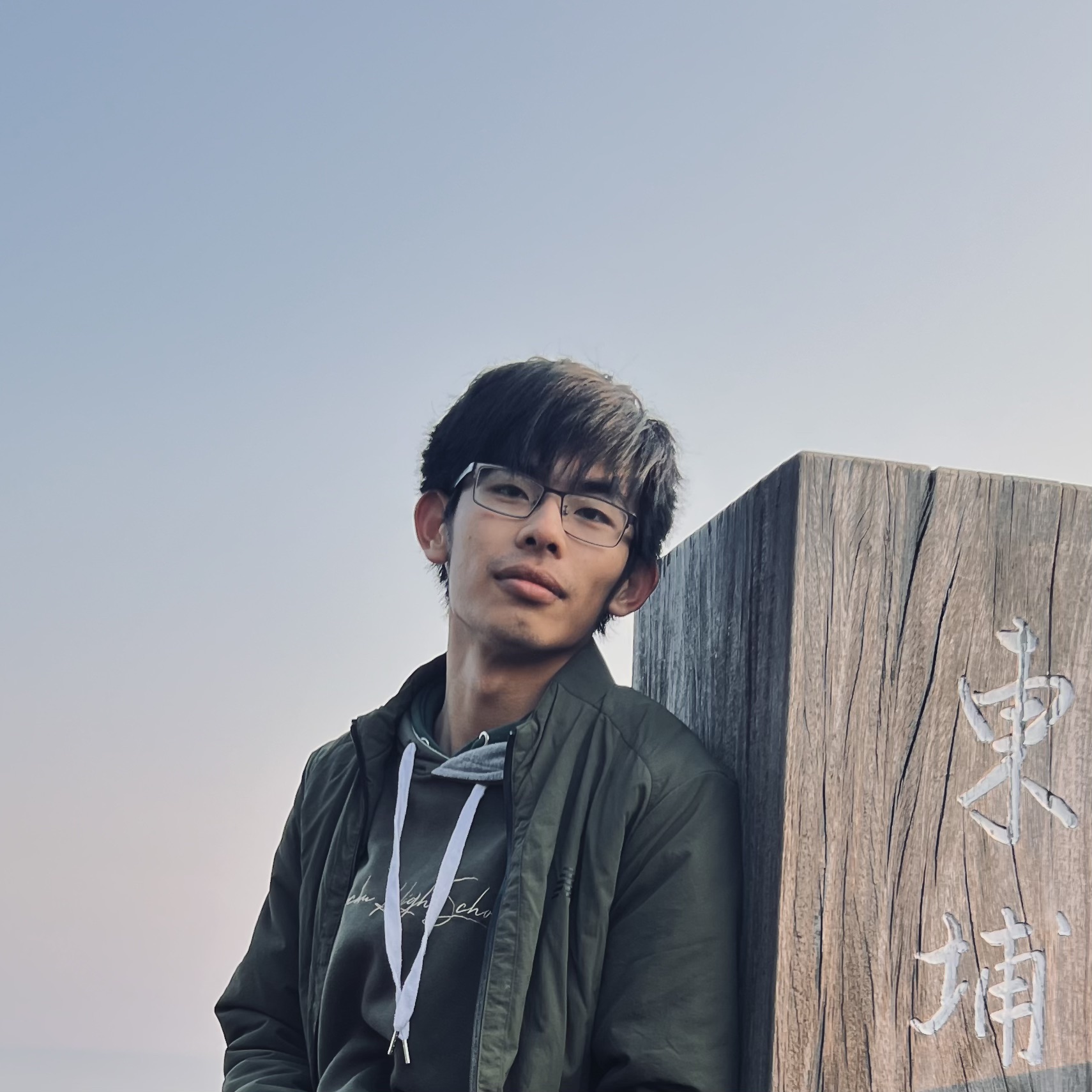
Current projects span coupled atmospheric chemistry and climate, upper-atmosphere escape, and transport in Solar System and exoplanet atmospheres.
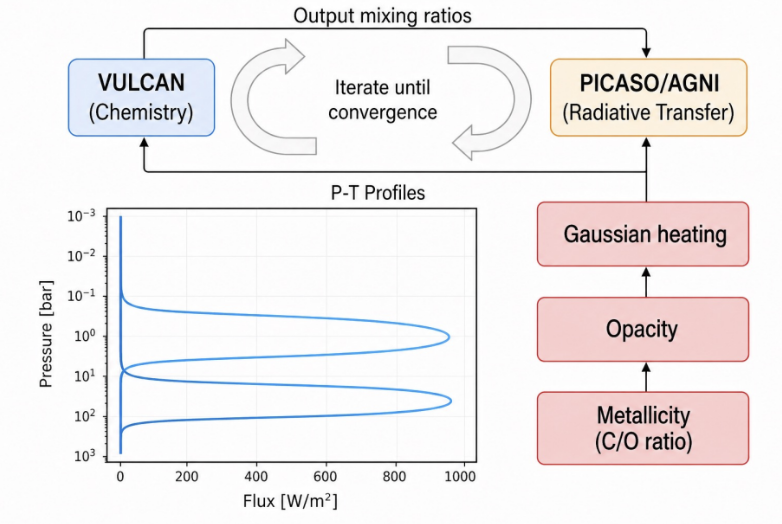
We use a coupled VULCAN–PICASO framework to study how atmospheric chemistry and radiative–convective structure jointly shape the distribution of sulfur-bearing species across exoplanet environments.
We model the upper atmosphere of the ultra-hot Jupiter WASP-33 b to investigate atmospheric escape and compare synthetic metastable-helium absorption with observations.
We develop a microphysical condensation–evaporation model within a two-dimensional chemical-transport framework, coupling atmospheric dynamics, aerosol transport, and photochemistry to investigate the vertical D/H profile in Venus’s middle atmosphere.
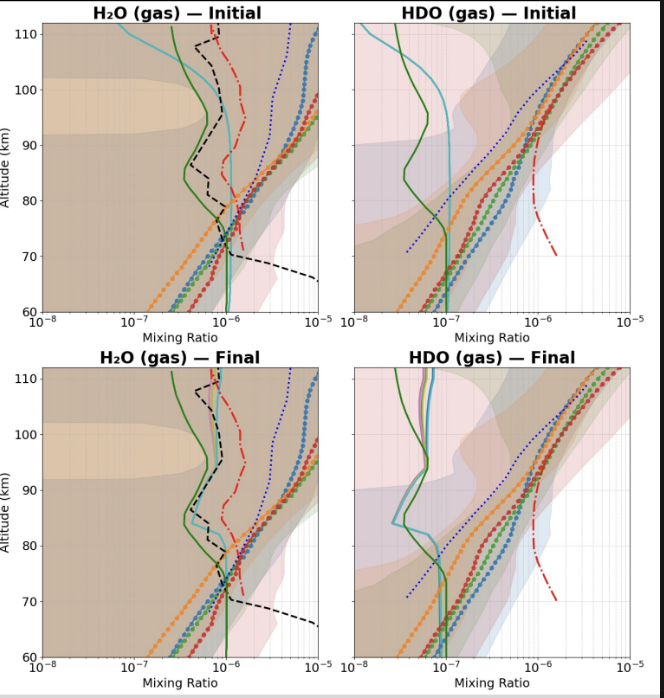
We use VULCAN with coupled radiative-transfer modeling to investigate how deep energy deposition reshapes the thermal structure and chemical composition of WASP-193 b, and how those changes may appear in JWST observations.
Earlier projects in extragalactic astronomy and small-body science developed the observational and computational perspective that now informs my planetary-atmosphere research.
Using JWST/MIRI CEERS sources to investigate the growth history of obscured active galactic nuclei.
Read the PASA paperDeveloping simulated light curves and machine-learning approaches to identify binary asteroids in survey data.
Research articles and conference contributions are listed separately to make publication status clear. A fuller record of research and public talks is available on the presentations page.
C.-A. Hsieh, T. Goto, C.-T. Ling, S. J. Kim, T. Hashimoto, T. C.-C. Chien, and A. Y.-A. Chen
Publications of the Astronomical Society of Australia, 42, e095
C. A. Hsieh, T. J. Liao, F. P. Mills, C. D. Parkinson, and Y. L. Yung
AGU Fall Meeting Abstracts
Oral presentation · ASROC Annual Meeting
Oral presentation · ASROC Annual Meeting
Poster · Annual Meeting of the Physical Society of Taiwan · Poster Award (Honorable Mention)
Oral presentation · AGU Fall Meeting
Poster · Annual Meeting of the Astronomical Society of the Republic of China
A concise selection of research, academic, outreach, and earlier science awards.
Annual Meeting of the Physical Society of Taiwan
Summer Undergraduate Research Fellowship
National Taiwan University
Taiwan Physical Society
Summer research program
International Earth Science Olympiad (IESO)
Research is one part of how I engage with science. I also organize astronomy education, give public talks, and write science and fiction for broader audiences.
Expanding access to STEM through astronomy and nature education in rural communities.
Selected public talks on astronomy and planetary science.
Leading astronomy organizations to foster community engagement.
Writing and sharing knowledge to inspire curiosity in astronomy.
Contributing to the EASY astronomy and Earth science outreach team.
Short fiction recognized in Taiwanese literary competitions.
For research questions, collaborations, or opportunities, email me or explore my public work and code.